
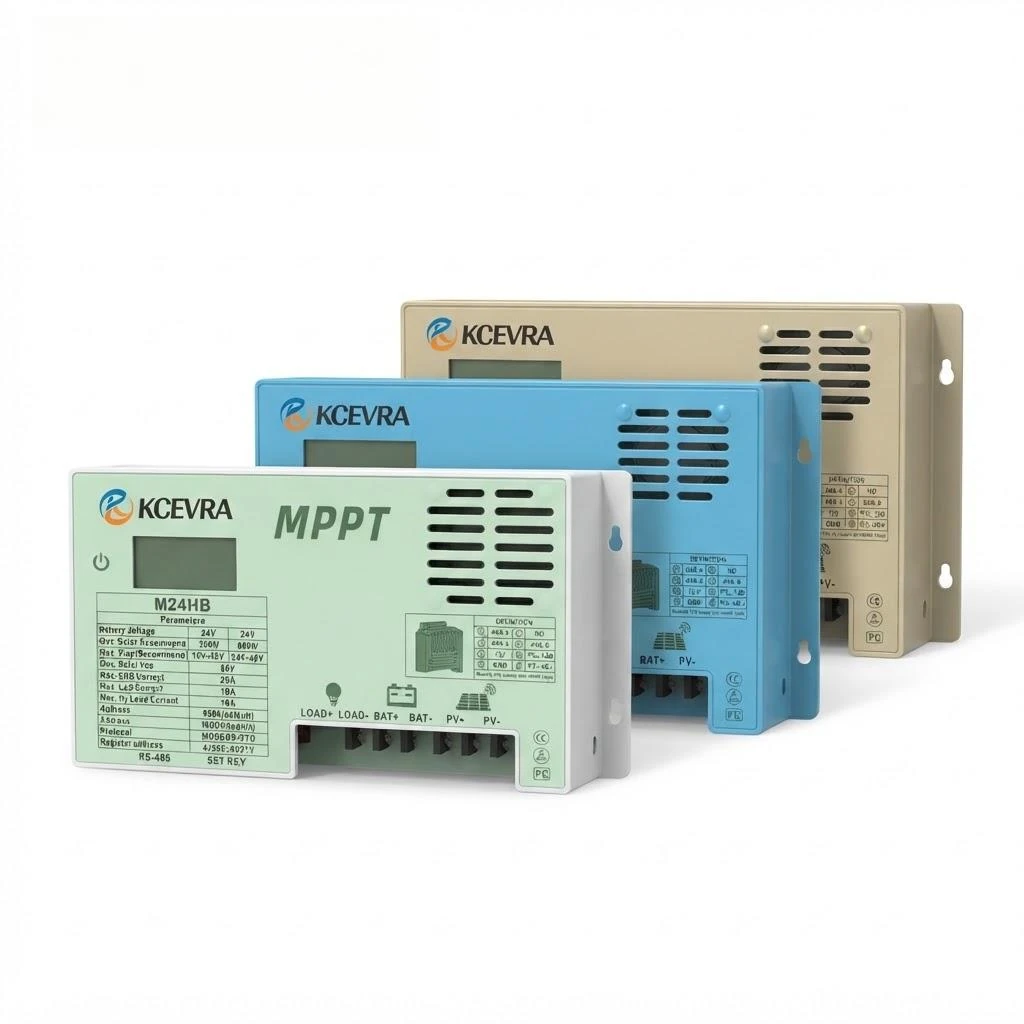
What Is an MPPT Solar Charge Controller?
An MPPT solar charge controller is a device that manages power between a solar panel array, a battery bank, and connected DC loads. MPPT stands for Maximum Power Point Tracking. The controller continuously adjusts the solar array’s operating voltage and current to harvest available power efficiently, then converts that power into a suitable charging output for the battery.
Unlike a basic PWM controller, an MPPT solar charge controller can electrically separate the solar panel voltage from the battery voltage. This allows a higher-voltage PV array to charge a lower-voltage battery while increasing the available charging current after conversion. Victron Energy explains this voltage-conversion principle in its technical documentation.
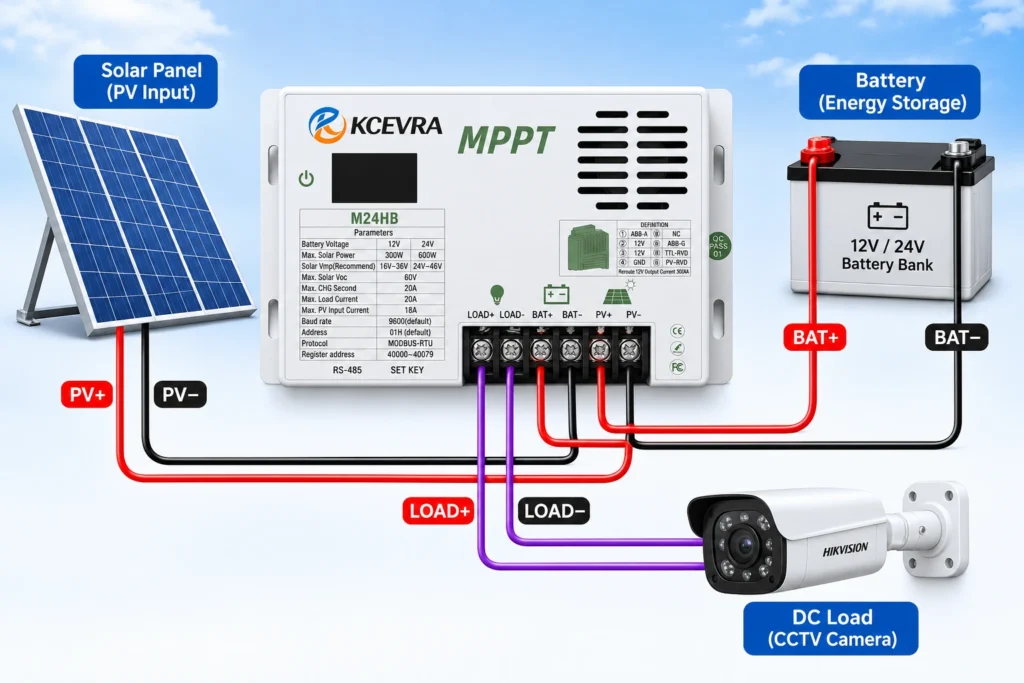
What Does MPPT Mean in Solar Power?
A solar panel does not produce the same power at every voltage. Its output changes with sunlight intensity, cell temperature, shading, and electrical load.
The maximum power point is the voltage and current combination at which the solar array produces its highest available power:
Power = Voltage × Current
An MPPT controller measures the PV operating conditions and searches for this point. When sunlight or temperature changes, the maximum power point also moves. The controller adjusts its operating point automatically so the array can continue working near its most productive region.
MPPT does not create additional energy. It helps the system use more of the energy that the solar array can provide under the actual operating conditions.
How Does an MPPT Solar Charge Controller Work?
1. It tracks the solar array’s maximum power point
The controller monitors PV voltage and current, calculates the resulting power, and changes the electrical operating point. The tracking process responds to changing irradiance and temperature.
Partial shading or mismatched modules can create more complicated PV curves with multiple power peaks. For this reason, array design, module matching, cable sizing, and shading analysis still matter even when an MPPT controller is used. Morningstar notes that shading, dust, and mixed PV modules can affect power-point tracking.
2. It converts PV power to the battery charging voltage
Most MPPT solar charge controllers use a DC-DC conversion stage. The controller may receive higher PV voltage and lower PV current, then convert it to a lower battery voltage with higher charging current.
For example, a solar array may operate at a voltage well above the battery’s present charging voltage. The MPPT controller can use that voltage difference rather than pulling the PV array down to the battery voltage, as a PWM controller generally does.
Conversion is not lossless. The actual charging output depends on the controller’s conversion efficiency, PV conditions, battery voltage, temperature, wiring, and load.
3. It applies a battery charging algorithm
After locating and converting the available PV power, the controller regulates the charging process according to the battery type and configured voltage limits.
Depending on the model and battery profile, charging may include stages such as:
- Activation or battery recovery
- Bulk or constant-current charging
- Absorption or constant-voltage charging
- Float or maintenance charging
- Temperature-compensated charging
The correct charging profile depends on the battery chemistry, battery voltage, series configuration, and manufacturer’s charging requirements.
4. It manages connected loads
Many solar charge controllers include a load output for DC equipment. The controller may provide manual or automatic load modes, load status monitoring, and protection against overload or short circuit.
For remote monitoring systems, the load output can help coordinate battery charging, connected equipment operation, and low-voltage protection.<!– IMAGE 2: Insert after “It applies a battery charging algorithm” | Visual: Original technical diagram showing PV tracking, DC-DC conversion, battery charging stages, and load management | Alt: “MPPT solar charge controller operating principle from PV tracking to battery charging” | Source: original diagram –>
Main Components of an MPPT Charge Controller
A typical MPPT solar charge controller contains several functional sections:
PV input stage
The PV input receives power from the solar array. Its allowable open-circuit voltage, operating voltage range, input current, and maximum PV power must match the array design.
MPPT control algorithm
The control algorithm measures PV conditions and adjusts the operating point to locate the maximum power region. Its performance depends on the controller design and actual array conditions.
DC-DC power stage
The power stage converts the PV input into a battery-compatible charging output. A buck controller reduces voltage from the PV array to a lower battery voltage.
Battery charging and monitoring section
This section controls charging voltage, charging current, battery type, temperature compensation, and battery protection limits.
Load output section
Where provided, the load output supplies connected DC equipment and may support automatic load control, overload protection, and short-circuit protection.
Thermal management and protection
Protection functions may include PV overvoltage, PV reverse polarity, PV short circuit, input power limiting, overtemperature, load overload, load short circuit, battery overvoltage, battery over-discharge, and nighttime reverse charging.
Types of MPPT Solar Charge Controllers
MPPT controllers can be grouped by conversion topology, battery platform, output current, communication capability, and application.
Buck MPPT controllers
A buck MPPT controller reduces a higher PV voltage to a lower battery charging voltage. The documented M24HB, M24HC, and M48HC controllers are buck-type products.
Controllers for different battery platforms
Battery platform is one of the most important classification factors.
- M24HB supports 12V and 24V battery platforms.
- M24HC supports 12V and 24V battery platforms.
- M48HC supports 12V, 24V, 36V, and 48V battery platforms.
A controller designed for a 48V battery system should not be selected only by its charging-current rating. The PV voltage range, battery charging profile, maximum PV power, and protection limits must also be compatible.
Controllers with communication and monitoring
For remote solar systems, communication can be as important as charging power. The documented controllers support RS485 and TTL communication using Modbus. Optional Bluetooth or Ethernet functions may be available depending on the model and configuration.
Local displays may show PV voltage, PV charging current, PV power, battery voltage, state of charge, load status, operating condition, and historical generation data.
MPPT vs PWM Solar Charge Controllers
| Comparison point | MPPT controller | PWM controller |
|---|---|---|
| PV operating voltage | Tracks the PV array’s maximum power point | Usually pulls PV voltage closer to battery voltage |
| Voltage relationship | Can accept a higher PV voltage than the battery platform within its limits | PV and battery voltage must be more closely matched |
| Energy utilization | Generally better when PV voltage is significantly higher than battery voltage or conditions vary | Simpler and suitable for closely matched, smaller systems |
| Conversion stage | Uses active power conversion | Uses simpler switching regulation |
| System design | Requires careful matching of PV voltage, current, and power limits | Usually has simpler voltage matching requirements |
| Cost and complexity | Typically higher | Typically lower |
MPPT is not automatically the correct choice for every small solar system. The decision should consider PV voltage, battery platform, array power, available sunlight, system size, load profile, and project budget.
Common Applications
Off-grid CCTV systems
An MPPT controller can regulate solar charging for cameras, wireless bridges, routers, and other DC loads where grid power is unavailable. The design must account for camera operating power, PTZ startup power, nighttime consumption, battery autonomy, and local solar conditions.
Remote IoT and environmental monitoring
Remote weather stations, water monitoring equipment, agricultural sensors, air-quality devices, and RTU or DTU systems often require stable low-voltage power and communication interfaces. RS485 and Modbus can support integration with monitoring or control equipment.
Wireless communication systems
Solar-powered wireless bridges, industrial routers, telecom nodes, and remote network devices require compatibility between the controller’s battery output, the equipment’s input voltage, and its startup current.
Outdoor and off-grid DC loads
An MPPT controller can be used in remote lighting, field equipment, transportation monitoring, and other applications where solar panels, batteries, and DC loads must operate as one power system.
Documented MPPT Controller Range
The following specifications summarize the documented M24HB, M24HC, and M48HC models. Always confirm the latest model-specific manual before final system design.
| Model | Battery platform | Rated charge current | Maximum PV power | Maximum PV open-circuit voltage |
|---|---|---|---|---|
| M24HB | 12V / 24V | 20A | 300W at 12V; 600W at 24V | 56V |
| M24HC | 12V / 24V | 30A | 420W at 12V; 820W at 24V | 90V |
| M48HC | 12V / 24V / 36V / 48V | 30A | 420W / 820W / 1080W / 1440W | 60V at 12V; 90V at 24V, 36V, and 48V |
The documented models also provide RS485 and TTL communication, Modbus support, display functions, battery-type configuration, load protection, PV protection, and temperature-related protection. M24HC and M48HC use natural cooling and fan cooling, with an IP32 enclosure rating stated in their manuals.
What Should Be Checked Before Using an MPPT Controller?
Before connecting an MPPT solar charge controller, confirm:
- The battery platform matches the controller.
- The battery chemistry and charging profile are supported.
- The PV array’s cold-weather open-circuit voltage remains below the controller’s maximum PV voltage.
- The PV operating voltage falls within the controller’s recommended Vmp range.
- The array power and current do not exceed the controller’s rated limits.
- The battery charging current is suitable for the battery manufacturer’s requirements.
- The load current and startup current are compatible with the load output.
- Communication interfaces match the monitoring or control equipment.
- The controller has adequate ventilation and protection from rain and direct water entry.
- Wiring polarity, fuses, disconnects, grounding, and cable sizes follow the applicable electrical requirements.
The manuals specifically warn that PV overvoltage can damage the controller. They also require careful handling of battery connections. When the battery activation function is enabled, battery reverse-polarity protection may not be available.
Frequently Asked Questions
Does an MPPT controller increase solar panel power?
No. It does not create energy. It tracks the panel’s available maximum power point and converts that power into a suitable battery charging output. Actual results depend on sunlight, temperature, shading, array design, wiring, battery voltage, and conversion efficiency.
Can an MPPT controller charge a 12V battery from a higher-voltage solar array?
Yes, if the controller is designed for buck conversion and the PV voltage, open-circuit voltage, current, and power remain within its specified limits.
Is MPPT always better than PWM?
MPPT is generally more capable when the PV array voltage is higher than the battery voltage, when conditions vary, or when the system needs better energy utilization. PWM may still be suitable for smaller systems with closely matched PV and battery voltages.
Does MPPT replace a battery management system?
No. An MPPT controller manages solar charging and load-side power according to its configuration. Lithium battery systems may also require a separate battery management system and charging limits specified by the battery manufacturer.
Can one MPPT controller support multiple battery voltages?
Only when the specific model supports those platforms and is configured correctly. For example, the M24HB and M24HC are documented for 12V and 24V systems, while the M48HC extends to 36V and 48V platforms.
Choose an MPPT Controller Based on the Complete Power System
The correct MPPT solar charge controller is determined by the relationship between the solar array, battery, load, environment, and communication requirements. For a project-specific recommendation, prepare the following information:
- Battery voltage and chemistry
- Battery capacity and series configuration
- PV module Voc and Vmp
- Total PV wattage and array configuration
- Maximum charging current
- Continuous and startup load power
- Required backup time
- Installation environment
- Required RS485, TTL, Modbus, Bluetooth, or Ethernet functions
You can visit KCEVRA to request the relevant MPPT controller information and discuss a compatible configuration for off-grid CCTV, IoT, monitoring, communication, or other remote DC power applications.