
MPPT vs PWM Solar Charge Controller: Complete Comparison
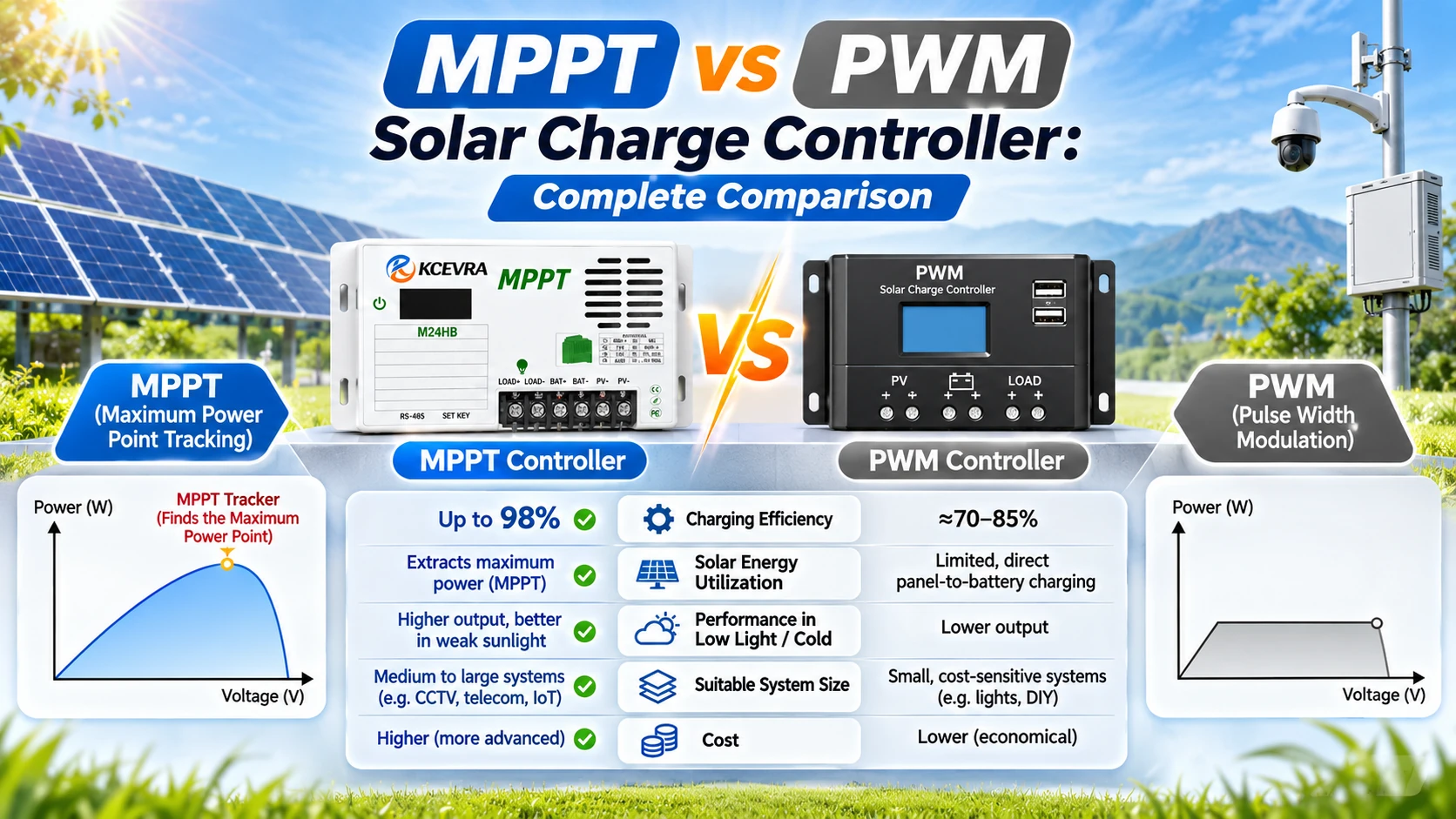
MPPT and PWM are the two main types of solar charge controllers.
Choose an MPPT solar charge controller when the PV array voltage is higher than the battery voltage, the system is medium-sized or large, the cable run is long, or energy harvest is important. Choose a PWM controller when the solar panel voltage closely matches the battery voltage and the system is small, simple, and cost-sensitive.
Neither technology is universally better. The right choice depends on PV voltage, battery platform, climate, load profile, wiring distance, and total system cost.
What Is the Difference Between MPPT and PWM?
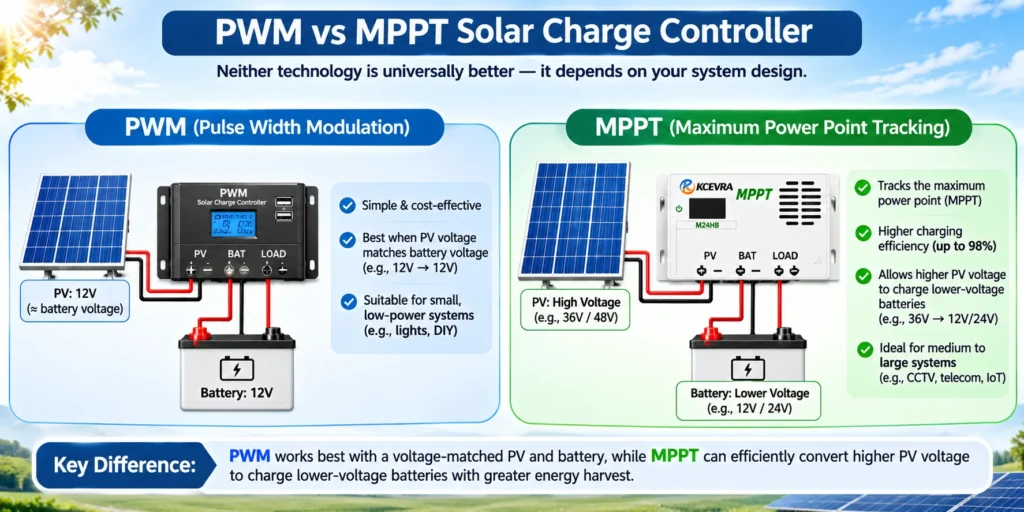
PWM stands for Pulse Width Modulation. A PWM controller connects the solar array to the battery through a switching process. During charging, the PV voltage is pulled close to the battery voltage.
MPPT stands for Maximum Power Point Tracking. An MPPT controller operates the solar array near its maximum power voltage, then uses a DC-DC conversion stage to provide a suitable battery charging voltage. This separates the PV voltage from the battery voltage.
For example, a solar array may operate at a higher voltage while charging a 12V battery. An MPPT controller can convert the higher PV voltage into a higher charging current, subject to conversion losses and the controller’s rated limits. Victron Energy describes this voltage-conversion difference in its technical comparison.
MPPT vs PWM at a Glance
| Comparison point | MPPT solar charge controller | PWM solar charge controller |
|---|---|---|
| Operating principle | Tracks the PV maximum power point and converts voltage | Connects the PV array to the battery through pulse-width switching |
| PV voltage | Can be substantially higher than battery voltage within the controller’s limits | Must be closely matched to battery voltage |
| Energy harvest | Usually higher when PV voltage is above battery voltage or conditions vary | Suitable when the panel and battery are closely matched |
| PV module flexibility | Supports a wider range of module and string configurations | More limited by voltage matching |
| Cable requirements | Higher PV voltage can reduce array current and cable losses | Lower PV voltage may require higher current for the same power |
| System complexity | More electronics, configuration, and sizing requirements | Simpler installation and operation |
| Purchase cost | Usually higher | Usually lower |
| Typical use | Larger off-grid systems, remote equipment, long cable runs, variable conditions | Small, simple systems with matched PV and battery voltages |
How MPPT and PWM Use Solar Panel Power
A solar panel has a current-voltage curve. The product of voltage and current is power:
Power = Voltage × Current
The maximum power point is the point on that curve where the solar panel produces its highest available power.
PWM operation
A PWM controller generally operates the array close to the battery voltage. If the panel’s maximum power voltage is significantly higher than the battery voltage, the panel may not operate at its maximum power point.
PWM can still be effective when the panel is specifically designed for the battery voltage and the system is small. Its simpler design can also reduce initial equipment cost.
MPPT operation
An MPPT controller measures PV voltage and current, searches for the maximum power point, and adjusts the input operating point as sunlight and temperature change.
The controller then converts the PV power into a battery-compatible output. If the input voltage is higher than the battery charging voltage, the output current can increase after conversion, although the final result is reduced by conversion, wiring, temperature, and other system losses.
Which Controller Produces More Energy?
MPPT generally produces more usable energy when:
- The PV array voltage is substantially higher than the battery voltage
- The system operates in cold or variable weather
- The PV array has a long cable run
- The battery voltage is low during charging
- The system uses higher-voltage solar modules
- The system requires better energy collection during weak sunlight
The improvement is not a fixed percentage. It depends on array voltage, temperature, irradiance, battery state, controller efficiency, and system design. Morningstar describes MPPT gains over PWM as condition-dependent rather than universal, with the advantage increasing when array voltage is higher than battery voltage. See Morningstar’s PWM vs MPPT comparison.
A correctly sized PWM system may perform well when the PV module and battery voltage are closely matched. In that situation, the additional conversion stage of an MPPT controller may not provide enough energy benefit to justify its higher cost.
MPPT vs PWM for Different Climates
Temperature changes the voltage of a solar panel.
As panel temperature rises, PV voltage generally falls. In colder conditions, PV voltage generally rises. This affects the difference between the panel’s maximum power voltage and the battery voltage.
MPPT usually has a stronger advantage when:
- The climate is cold or temperate
- The array voltage is well above battery voltage
- Solar conditions change frequently
- The battery voltage falls during a deep discharge
PWM may remain a practical choice for small systems in warm climates where the panel voltage is already closely matched to the battery voltage. Climate alone should not determine the choice; the module datasheet and battery platform must also be checked.
MPPT vs PWM for Cable Distance and System Layout
For the same solar power, a higher PV voltage means lower PV current:
Current = Power ÷ Voltage
Lower current can reduce voltage drop and resistive cable losses. It may also allow a longer PV cable run or a smaller cable cross-section, subject to local electrical requirements and allowable voltage drop.
This is one reason MPPT controllers are often used in remote CCTV, communication, IoT, and industrial monitoring systems. The PV array can be configured at a higher voltage while the controller provides the required battery charging voltage.
The benefit only exists when the controller supports the PV voltage. The array’s cold-weather open-circuit voltage must remain below the controller’s maximum input voltage.<!– IMAGE 2: Insert after “Lower current can reduce voltage drop…” | Visual: Cable-loss comparison showing the same solar power transmitted at lower voltage and higher current versus higher voltage and lower current | Alt: “Solar PV cable current and voltage comparison for MPPT system design” | Source: original diagram –>
MPPT vs PWM for Battery Compatibility
Both controller types must be matched to the battery.
The selection should consider:
- Battery voltage platform
- Battery chemistry
- Series battery configuration
- Maximum charging current
- Absorption and float voltage
- Temperature compensation
- Battery protection requirements
- Battery management system requirements for lithium batteries
An MPPT controller does not replace a battery management system. Lithium batteries may require their own cell balancing, overvoltage, undervoltage, and temperature protection.
The charger must also support the battery manufacturer’s charging requirements. Selecting a controller only by its ampere rating can result in an incorrect charging profile.
MPPT vs PWM for Remote CCTV and IoT Systems
MPPT is generally more suitable for remote systems when the available PV voltage is higher than the battery voltage or when the system must maximize energy collection.
Typical applications include:
- Solar-powered CCTV cameras
- PTZ cameras with higher startup power
- Wireless bridges and routers
- Remote environmental monitoring
- Water and weather monitoring equipment
- Agricultural sensors
- Industrial IoT equipment
- Remote telecom and communication nodes
These systems may also require RS485, TTL, Modbus, local display functions, or optional network communication. Load startup current and nighttime energy consumption should be included in the design.
PWM can be suitable for a small camera or sensor system when the PV module is already matched to the battery and the power demand is modest.
How the Documented MPPT Models Compare
The documented MPPT controller range includes M24HB, M24HC, and M48HC models. These are step-down MPPT controllers designed for different battery platforms and PV power levels.
| Model | Battery platform | Rated charge current | Maximum PV power | Maximum PV open-circuit voltage |
|---|---|---|---|---|
| M24HB | 12V / 24V | 20A | 300W at 12V; 600W at 24V | 56V |
| M24HC | 12V / 24V | 30A | 420W at 12V; 820W at 24V | 90V |
| M48HC | 12V / 24V / 36V / 48V | 30A | 420W / 820W / 1080W / 1440W | 60V at 12V; 90V at 24V, 36V, and 48V |
The models also support combinations of:
- Lithium, LiFePO4, lead-acid, gel, and user-defined battery settings
- RS485 and TTL communication
- Modbus communication
- Local display and SOC information
- Battery temperature monitoring
- Charge-current and charge-power settings
- PV overvoltage and reverse-polarity protection
- Load overload and short-circuit protection
- Overtemperature protection
- Nighttime reverse-charging protection
The exact PV range, charge current, battery configuration, and protection behavior must be confirmed against the selected model’s latest specification sheet.
When Should You Choose MPPT?
Choose MPPT when:
- The PV module Vmp is materially higher than the battery charging voltage
- You need to connect higher-voltage modules to a lower-voltage battery system
- The PV array is more than a small residential or portable setup
- The PV cable run is long
- The system operates in cold, cloudy, or variable conditions
- The project requires higher energy utilization
- You need RS485, Modbus, data logging, or remote monitoring
- The system must support 12V, 24V, 36V, or 48V battery platforms
For systems with higher PV power, the extra MPPT cost may be offset by better energy harvest, lower PV current, and more flexible system configuration.
When Should You Choose PWM?
Choose PWM when:
- The system is small and cost-sensitive
- The solar panel is designed for the battery voltage
- The PV cable run is short
- The panel and battery voltage are closely matched
- The battery is usually full or the load is very small
- Advanced monitoring and communication are not required
- The expected MPPT energy gain would be limited by the operating environment
PWM is not automatically an inferior choice. It can be technically appropriate when the system conditions match its operating principle.
Important Sizing Checks
Before ordering either type of controller, confirm:
- PV open-circuit voltage under the lowest expected temperature
- PV operating voltage at the expected panel temperature
- Total PV wattage
- Maximum PV input current
- Battery voltage and chemistry
- Maximum charging current
- Continuous and startup load power
- Required backup time
- Cable length and allowable voltage drop
- Communication and monitoring requirements
- Ventilation and enclosure conditions
- Fuse, disconnect, grounding, and polarity requirements
Do not compare MPPT and PWM using only the controller’s charging-current rating. PV voltage, battery voltage, array power, temperature, and cable design can change the result significantly.
MPPT or PWM Which Is Better?
MPPT is usually the better technical choice for higher-voltage PV arrays, larger off-grid systems, remote equipment, long cable runs, and projects where available solar energy must be used efficiently.
PWM is often the better economic choice for small systems with closely matched PV and battery voltages, simple loads, short cables, and limited energy requirements.
For a project-specific recommendation, prepare the battery voltage and chemistry, PV module Voc and Vmp, total array wattage, cable distance, continuous load, startup load, required autonomy, installation climate, and communication requirements. KCEVRA can then help identify the appropriate controller configuration for off-grid CCTV, IoT, monitoring, communication, and other remote DC power applications.